 Skip to content
 Cambodia’s 500MW Hybrid Co‑Firing Power Plant: A Landmark Co‑Biomass Investment Opportunity for 2026
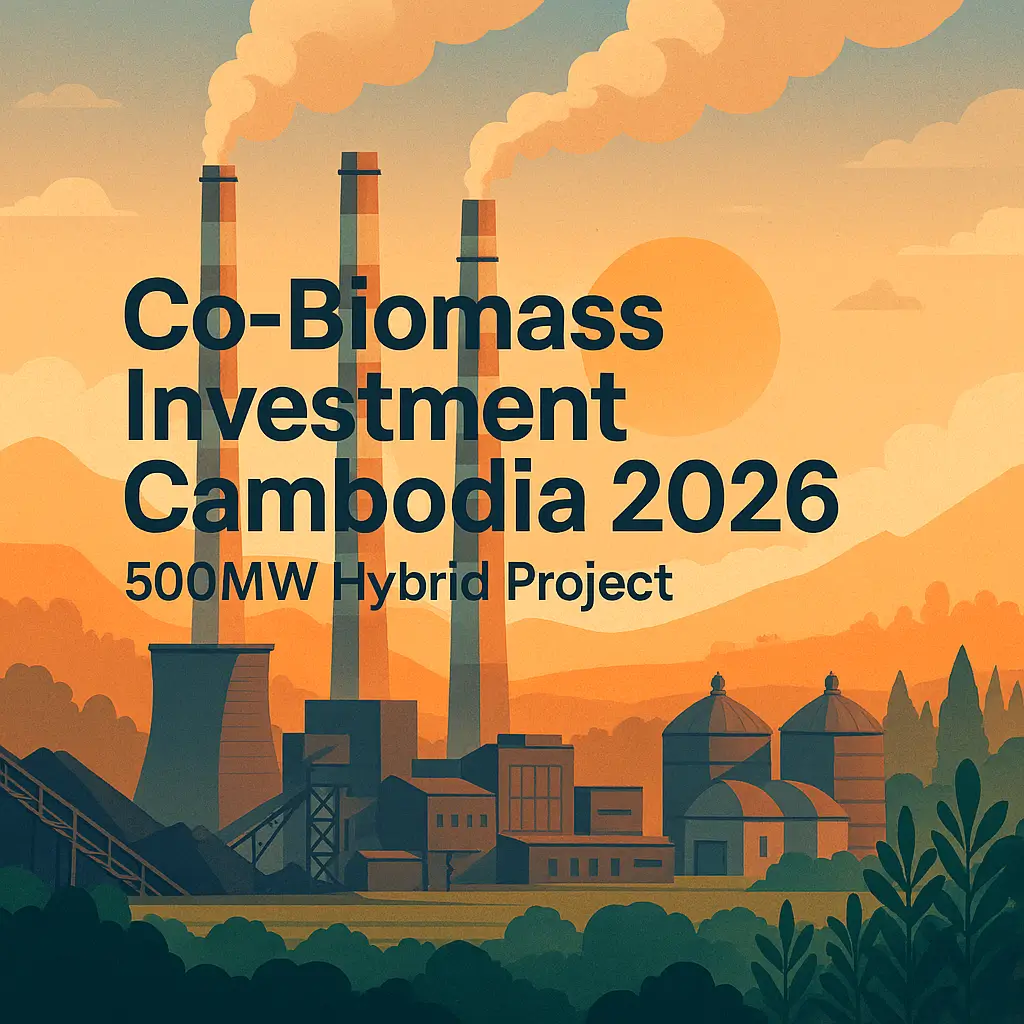
In the heart of Southeast Asia, Cambodia is a nation on the move. Its cities are expanding, factories are humming, and its economy is growing faster than many of its neighbors. Yet behind this momentum lies a pressing challenge: energy security.
For years, Cambodia has relied heavily on imported electricity from Vietnam, Thailand, and Laos. Hydropower dams have been built, solar farms have been installed, but the grid still struggles with stability. Hydro output drops by more than half during the dry season, and solar power vanishes when the sun sets. The country’s growth story risks being slowed by a simple but critical fact — the lights must stay on.
It is against this backdrop that a bold vision emerges: the 500MW Hybrid Co‑Firing Power Plant, a project designed not just to generate electricity, but to reshape Cambodia’s energy future.
The Birth of a Transition Asset
Imagine a power plant that draws strength from Cambodia’s own land — coal mined from domestic reserves and biomass harvested from fast‑growing plantations. This hybrid model blends 70% indigenous coal with 30% sustainable biomass, creating a balance between reliability and responsibility.
Coal provides the baseload stability that industries demand. Biomass, cultivated from dedicated forestry plantations, offsets carbon emissions and qualifies the project for international green financing. Together, they form what developers call a transition asset: a bridge between today’s energy needs and tomorrow’s carbon‑neutral commitments.
This is not a stranded coal plant destined to be obsolete. It is a Green‑Base Energy Project, designed to evolve, expand, and eventually integrate more renewable modules.
Sovereign Backing: A Rare Advantage
Few projects in emerging markets come with the kind of sovereign support this one enjoys. The Government Responsible Ministry (TBA) is not just a partner; it is the landlord, the facilitator, and the guarantor of security.
MOD provides:
5,000 hectares of coal concessions for mining.
Up to 240,000 hectares of forestry concessions for biomass plantations.
Site security and UXO clearance, ensuring safe development.
Fast‑tracked permits, cutting through bureaucratic delays.
For investors, this means reduced risk, accelerated timelines, and confidence that the project is aligned with national priorities.
The Numbers Behind the Vision
Every visionary project must stand on solid financial ground. Here, the numbers tell a compelling story:
CAPEX: $1.05 billion (~$2.1M per MW).
Annual Gross Revenue: $353 million.
Annual EBITDA: $240 million.
Net Income: ~$180 million steady state.
EBITDA Margin: ~68%.
Unlevered IRR: 14–16%.
Levered Equity IRR: 18–20%.
Payback Period: ~7 years.
These figures are anchored by a 35‑year take‑or‑pay PPA with Electricité du Cambodge (EDC). In simple terms, EDC guarantees to purchase 100% of the plant’s output, whether it is dispatched or not. For investors, this is revenue certainty — the kind of contractual security that makes financing bankable.
A Roadmap to Scale
The 500MW plant is only the beginning. Phase 1 establishes the foundation, but the vision stretches further:
Phase 2 (Years 5–7): Expansion to 1,000MW as plantations mature and mining scales.
Phase 3 & 4 (Years 8–12): Growth to 1,500MW and ultimately 2,000MW, with potential to export power to Vietnam and Thailand via the ASEAN Power Grid.
This phased approach allows investors to manage capital exposure while scaling alongside Cambodia’s rising demand.
Risks and Resilience
No project is without risks. Fuel supply could falter, off‑take agreements could be challenged, political winds could shift. Yet each risk has been carefully considered and mitigated:
Fuel Supply: Hybrid buffer design allows shifting ratios (e.g., 90% coal / 10% biomass) if biomass yields dip. Oversized concessions provide a safety margin.
Off‑Take: Sovereign‑backed take‑or‑pay PPA ensures payment regardless of dispatch.
Political Risk: Direct Government Responsible Ministry partnership provides the highest level of sovereign protection. Investors may also seek political risk insurance through MIGA.
Currency Risk: Dollar‑denominated PPA eliminates exposure to local currency fluctuations.
Environmental Risk: Robust ESIA, replanting commitments, and biodiversity safeguards ensure compliance and community acceptance.
This is a project built not just for profitability, but for resilience.
ESG Impact: Profit with Purpose
In today’s investment climate, profitability alone is not enough. Funds and developers are increasingly judged by their ESG credentials. This project delivers on all three fronts:
Environmental: Biomass co‑firing reduces carbon intensity, qualifying for carbon credits and aligning with Cambodia’s carbon neutrality pledge.
Social: Forestry plantations create rural jobs; a portion of project returns is pledged to education and child welfare programs.
Governance: Structured as a transparent public‑private partnership, with clear roles for Government Responsible Ministry (TBA), investors, and EDC.
Investors here don’t just earn returns — they help power a nation’s path to sustainability.
A Story of Legacy
Picture Cambodia in 2035. The grid is stable, industries thrive, and the country exports power to its neighbors. At the heart of this transformation stands the Hybrid Co‑Firing Complex, expanded to 2,000MW, a symbol of resilience and foresight.
For the investors who acted in 2026, this is not just a financial success. It is a legacy. Their capital didn’t just generate electricity; it fueled growth, empowered communities, and positioned Cambodia as a leader in sustainable energy.
Next Steps for Visionary Partners
For investors and developers ready to engage, the path is clear:
Submit a Letter of Interest (LOI) and proof of funds.
Sign an NDA to access detailed site data.
Execute an MOU with MOD and secure exclusivity with a refundable security deposit.
Commission feasibility studies and finalize PPA negotiations.
Proceed to financial close and staged construction.
Contact:
Conclusion: The Moment to Act
The 500MW Hybrid Co‑Firing Power Plant is more than an energy project. It is Cambodia’s turning point — a chance to secure energy independence, reduce carbon emissions, and build a foundation for regional leadership.
For investors and developers with capital, this is the moment to act. The returns are strong, the risks are mitigated, and the impact is profound. By investing, you don’t just participate in a project — you help write the next chapter of Cambodia’s growth story.


